
We've been saying the same things to founders for a decade. Make a pitch deck. Email a hundred VCs. Get warm intros and raise as much as possible.
Some of that was fine advice in 2018. In 2026, it's the reason most raises stall.
The fundraising environment has shifted over the last decade. Today, investors extensively use AI to screen deals before a partner reads a single slide. The median gap between a seed round and Series A has stretched to over 600 days, according to Carta's Q4 2025 data. About 46% of seed rounds are now bridge rounds, not fresh capital. And the global startup failure rate sits stubbornly at 90%, with 42% of those failures tied to building something the market didn't need (CB Insights post-mortem analysis, from 400+ startups).
The founders who are raising well in 2026 are doing something different from the advice they were given.
The "cold email 100 VCs" approach died quietly:
The numbers killed it. Only about 0.05% of startups receive venture capital funding at all. Of those that do get an equity check, just 8% succeed at closing. The combined odds work out to roughly 1 in 2,000. The numbers don’t lie.
And yet, the default advice is still "send your deck to as many investors as possible."
This made a kind of sense when VCs manually triaged inbound pitch decks. An associate would open each deal manually, skim the first three slides, and decide in 5-15 minutes if the deal deserved more diligence. More volume meant more chances.
That's not how it works anymore. VC firms now use AI-driven sourcing and screening tools that scan decks, digital footprints, and traction data before a human being touches the deal. A recent analysis found that AI-assisted initial screening cut review time from 45 minutes to 8 minutes per company in some funds (Bain). Firms like Antler made over 400 investments in 2025 alone, scaling toward 500 in 2026, which is only possible because their triage is automated.
The implication is quite straightforward: the quality of the materials, and the data room matters more than the number of inboxes they land in. 15 investors matched to the sector, stage, and cheque size will outperform 150 cold emails. But matching takes research, and most founders don't have the time or data to do it properly.
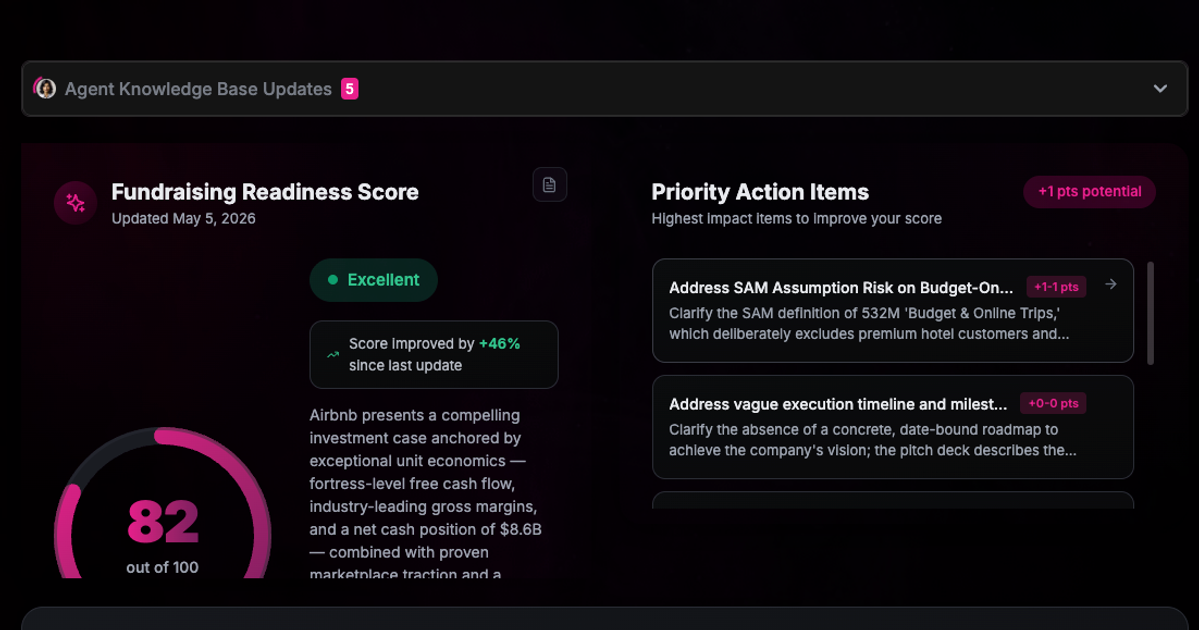
askRIA's Fundraising Agent uses a novel approach to solve this. When a founder uploads their deck and data room to askRIA, it builds their data room automatically; the platform shortlists investors based on sector, geography, stage, and thesis fit. The founder isn't guessing who might be interested. The agent surfaces investors who are actively deploying capital at that stage, in that vertical.
Pitch decks are the trailer. Investors are watching the full film.
As cliche as it may sound - the second piece of outdated advice is: "make a great pitch deck and the rest will follow."
In 2026, the pitch deck gets you the meeting. It doesn't get you the cheque. What gets you the cheque is the financial model, the cap table structure, data room, and how well each of them meet the investors thesis.
A detailed analysis from Pitchworx identified seven areas of "deep due diligence" that investors now scrutinise beyond the pitch: financial hygiene and unit economics, visual brand consistency, founder-market fit, digital reputation and AI visibility, customer validation, technical scalability, and cap table cleanliness. VC funds are running diligence earlier and more thoroughly than at any point in the past five years. The median Series A due diligence process absorbs roughly 118 personnel-hours spread across 83 days (Crunchbase).
Most founders walk into this unprepared simply because they've spent three weeks polishing slide transitions instead of building a data room that can withstand 100+ investor questions.
We've watched this pattern repeat. A founder spends months on a deck, gets meetings, and then crumbles during diligence because the financials are in three different spreadsheets, the cap table has unresolved SAFEs, and there's no clean answer for "what's your burn multiple?"
askRIA's Fundraising Agent addresses this directly. When a founder uploads their pitch deck, the agent generates 150+ investor-style questions drawn from the specific claims in their materials. Each question is ranked by difficulty with a suggested answer pulled from the founder's own documents. And gaps where the founder doesn't have a good answer are flagged before the first investor meeting itself.
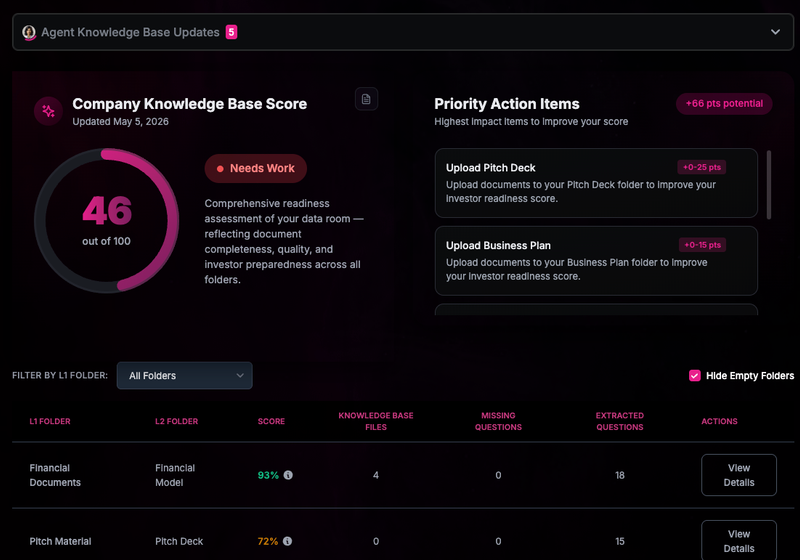
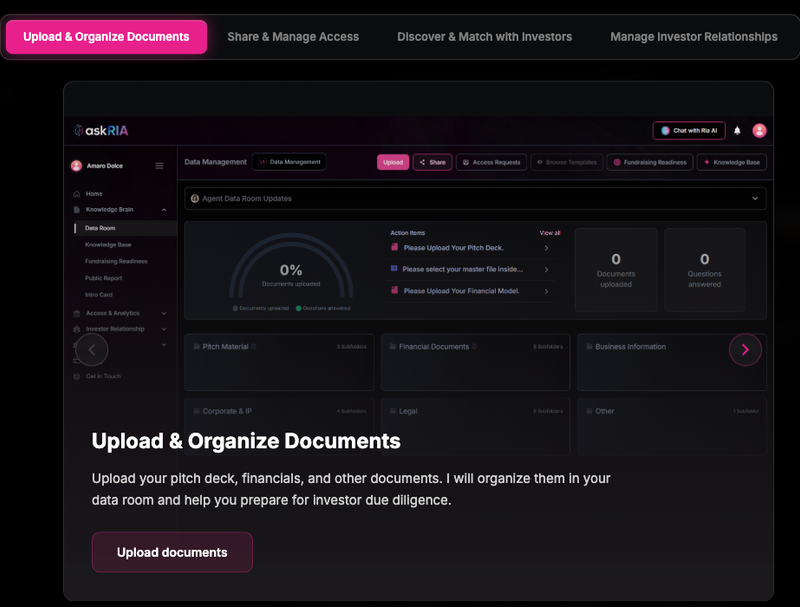
The agent also builds a structured data room automatically. Upload your deck, financials, and cap table. askRIA organises them, identifies missing documents, and generates an Investor Readiness Score. The data room isn't a folder of PDFs. It's a structured, searchable environment where each data point is traceable.
"Raise as much as possible" is terrible advice at seed
The third piece of conventional wisdom that's actively hurting founders is raise big, raise fast.
Oversized rounds at inflated valuations were the default in 2021. They created a generation of startups that couldn't grow into their valuations. Carta reports that Series A median post-money valuations jumped to $78.7 million in Q4 2025, up 37% year-on-year. But the startup cohort that raised in 2022 burned through $100 million in three years, double the cash-burn speed of earlier generations (private-market advisors cited by Digital Silk). About 85% of AI startups launched during that period are expected to be out of business within three years.
The pattern is consistent: raise too much, skip validation, burn through runway trying to find product-market fit, and close.
The smarter approach in 2026 is milestone-driven capital. Instead of raising 18 months of runway and hoping to hit product-market fit somewhere in the middle, work backwards from the milestone that will get the next round done. What metric needs to move? What does the financial model look like when it does? How much capital does that require?
This kind of planning is tedious. It requires financial modelling, scenario analysis, and a clear understanding of unit economics. Most seed-stage founders don't have a CFO, and hiring a fractional one costs £3,000 to £8,000 a month.
askRIA's Digital CFO Agent is built for exactly this. It connects to Xero, Stripe, and QuickBooks to model financials automatically, forecast runway, and track burn rate. No manual spreadsheets. No guesswork about dilution. But even before the CFO Agent, the Fundraising Agent's financial modelling templates give founders a clean, investor-grade model in about 10 mins.
The data room is where raises actually die
Nobody talks about this, but most raises don't fail at the pitch. They fail in the data room.
An investor takes a meeting. They're interested. They ask for more materials. The founder sends a Google Drive link with 40 unorganised files. The investor's associate spends an hour trying to find the cap table. They can't work out which financial model is current. They move on.
We've seen this happen to good companies with real traction. The product was solid. The deck was decent. But the data room looked like it was assembled the night before the meeting, because it was.
The gap between "documents" and "an investor-ready data room" is larger than most founders realise. An investor-ready data room has structure: pitch deck, executive summary, financial model, cap table, legal documents, product metrics, team bios, and reference contacts. Each section is labelled, current, and complete. Investors can find what they need in a matter of minutes.
When a founder uploads documents to askRIA, the Fundraising Agent automatically structures them into this format. It tells founders what documents are missing. It flags red flags in the financials and cap table before an investor sees them. And once the data room is shared, the founder can track which investor viewed which document, how long they spent on each section, and which questions they asked.
This engagement tracking is a founder-side advantage that most fundraising tools don't offer. It answers a question that keeps founders up at night: "Did they actually look at my materials, or did they ghost me?"
The other side of the table is changing too
Most fundraising advice talks about what founders should do. It completely ignores what investors are doing with AI.
VC firms in 2026 don't manually read data rooms. They run them through AI-driven diligence tools that extract questions, score answers, and flag risks in minutes. According to Gartner, over 75% of VC and early-stage deal reviews are now informed by AI. The deal scoring happens before the partner takes the meeting.
This means the founder's materials need to be structured for machine readability. A messy PDF with inconsistent formatting and buried metrics won't just annoy an associate. It'll score poorly in the AI screening that happens before the associate opens it.
For investors, askRIA's Due Diligence Agent automatically extracts 100+ diligence questions from a founder's shared materials, scores every answer, flags red and green signals, and benchmarks the deal against the investor's own custom investment thesis. The investor sees a score, a risk profile, and a list of unanswered questions before they've spent a single hour on manual review.
The investor's Due Diligence Agent can also request additional documents or clarification from the founder's Fundraising Agent. The founder's agent can surface the answer from materials already uploaded, or flag the request for the founder to respond. The whole exchange happens inside the platform. No email threads with "can you resend that file?"
This agent-to-agent communication is what differentiates askRIA from tools that only work for one side. Most fundraising platforms help founders or investors. askRIA connects the two in a shared workspace where information is symmetrical and structured, saving time and energy for the stakeholders involved.
What investor readiness actually looks like in 2026
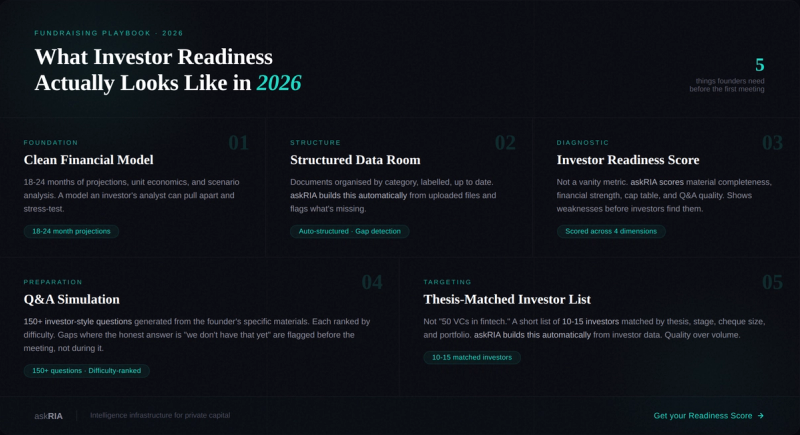
So what does "ready to raise" actually mean in 2026?
- A clean financial model with 18-24 months of projections, unit economics, and scenario analysis. A model that an investor's analyst can pull apart and stress-test.
- A structured data room where documents are organised by category, labelled clearly, and up to date. Missing items are identified and either filled or acknowledged with a clear timeline.
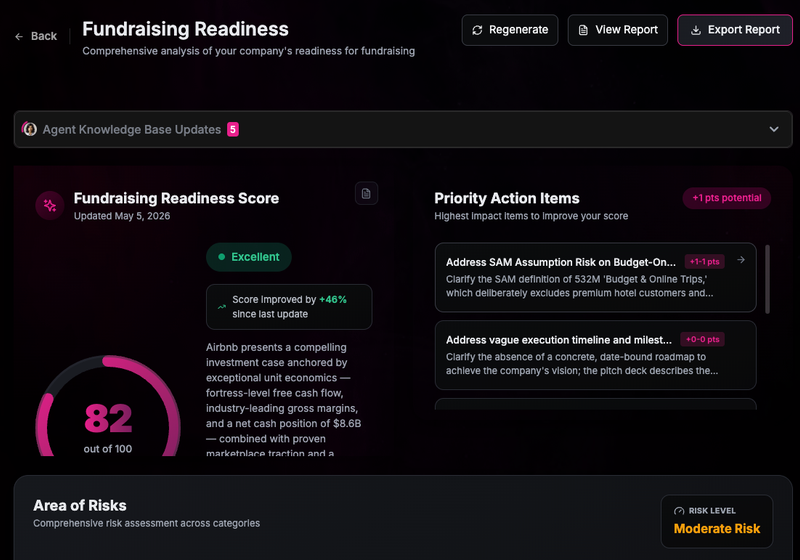
- An Investor Readiness Score. This is a real thing. askRIA generates one based on the completeness of the founder's materials, the strength of their financials, the cleanliness of their cap table, and the quality of their answers to simulated investor questions. It's not a vanity metric. It's a diagnostic that tells founders exactly where they're weak before an investor tells them.
- Practised answers to the hard questions through Q/A simulation. The founder has seen the 150 questions that investors are likely to ask, has prepared answers for each, and has identified the three or four where the honest answer is "we don't have that yet, and here's our plan."
- A targeted investor list. Not "50 VCs in fintech." A short list of 10-15 investors whose thesis, stage preference, cheque size, and portfolio composition align with the raise. askRIA's Fundraising Agent builds this list automatically from investor data.
This entire prep process used to take 6-8 weeks with a fundraising advisor charging £5,000 to £15,000. askRIA's Fundraising Agent does the data room, the readiness score, the Q&A simulation, and the investor shortlist in days at a fractional cost.
Stop following advice that was designed for a different market
The market in 2026 is not kinder or harsher than 2022. It's just more honest. Investors have better tools, faster screening, and less tolerance for founders who confuse a polished deck with being ready.
The old playbook told founders to optimise the pitch. The new reality demands that founders optimise for ever step and not just the pitch or the deck.
FAQs
- What is an Investor Readiness Score?
An Investor Readiness Score is a diagnostic that evaluates a founder's preparedness to raise capital. askRIA generates this score by assessing the completeness of the data room, the strength of the financial model, cap table cleanliness, and the quality of answers to simulated investor questions. It identifies specific weaknesses before investors do.
- What is a fundraising agent and how does it work?
A fundraising agent is an AI-powered tool that automates the operational side of raising capital. askRIA's Fundraising Agent builds structured data rooms from uploaded documents, generates 150+ investor-style questions based on the founder's specific materials, creates an Investor Readiness Score, shortlists thesis-matched investors, and tracks investor engagement with shared materials. It handles in days what traditionally takes weeks.
- How are investors using AI in due diligence in 2026?
According to Gartner, over 75% of VC and early-stage deal reviews are now informed by AI. Investor-side tools extract diligence questions from founder materials, score answers, flag red and green signals, and benchmark deals against the investor's own custom investment thesis. This means founder materials need to be structured for both human and machine readability.
- What should a startup data room include?
A fundraising-ready data room should include: a pitch deck, executive summary, financial model with projections and unit economics, cap table, legal documents (incorporation, shareholder agreements, IP assignments), product metrics and traction data, team bios, and reference contacts. askRIA's Fundraising Agent structures uploaded documents into this format automatically and identifies gaps.
- How much does fundraising preparation typically cost?
Keep reading
- startup data room checklist
- what investors see when they run AI on your pitch deck
- should you bootstrap or raise capital
Working with a fundraising advisor or investment bank for full data room preparation, financial modelling, and investor targeting typically costs between £5,000 and £15,000 and takes 6-8 weeks. askRIA's Fundraising Agent covers the data room, readiness score, Q&A simulation, and investor shortlisting in days at a fraction of that cost.